Letter from the Editor: PEN Annual Report 2025/2026
June 16, 2026 | Sarmishta Subramanian

This letter was originally published in the 2025/2026 PEN Canada Annual Report.
This spring, I found myself among a small group of artists, activists, and writers from Berlin, Philadelphia, Barcelona, and elsewhere, at a virtual art happening featuring Riwaa, a young Palestinian writer, and her collaborator, an Israeli artist and clown who calls herself “Officer Az-Oolay.” Riwaa has lived in a refugee camp in Khan Younis since her home in Rafah was bombed, and Az-Oolay lives in Jerusalem. The two are just an hour apart and correspond daily but have never met. On Zoom they would present their textand-sound work, “Sending Voice,” exhibited in Jerusalem a few months earlier.
But first—tea. Az-Oolay, in clown makeup and uniform bedecked with gaudy flowers, extended a cup through her camera. Riwaa, in hijab, separated from the night by the fabric of a tent, “received” it and drank. Then they passed a Kabukim, a candied-peanut snack. Through a sweet sleight-of-hand gag, they had seated themselves around a common table. The act of gathering could not undo the humanitarian crisis of the war in Gaza or the more than 72,000 Palestinian deaths, including those of writers who had voiced the experiences of their community. But it allowed an intimate exchange between two individuals, and what Riwaa described as the lifeline of artistic collaboration. “The enemy is known,” she told her audience, as well as Az-Oolay, who plies her craft at protests for Palestinian rights. “You are not the enemy.”
The problem of mass society, Hannah Arendt wrote, is not the number of people but that “the world between them has lost its power to gather them together, to relate and to separate them.” Arendt invoked the analogy of a séance, where the people around a table “might suddenly, through some magic trick, see the table vanish from their midst, so that two persons sitting opposite each other were no longer separated but also would be entirely unrelated to each other by anything tangible.” The table keeps us together, distinct yet attached.
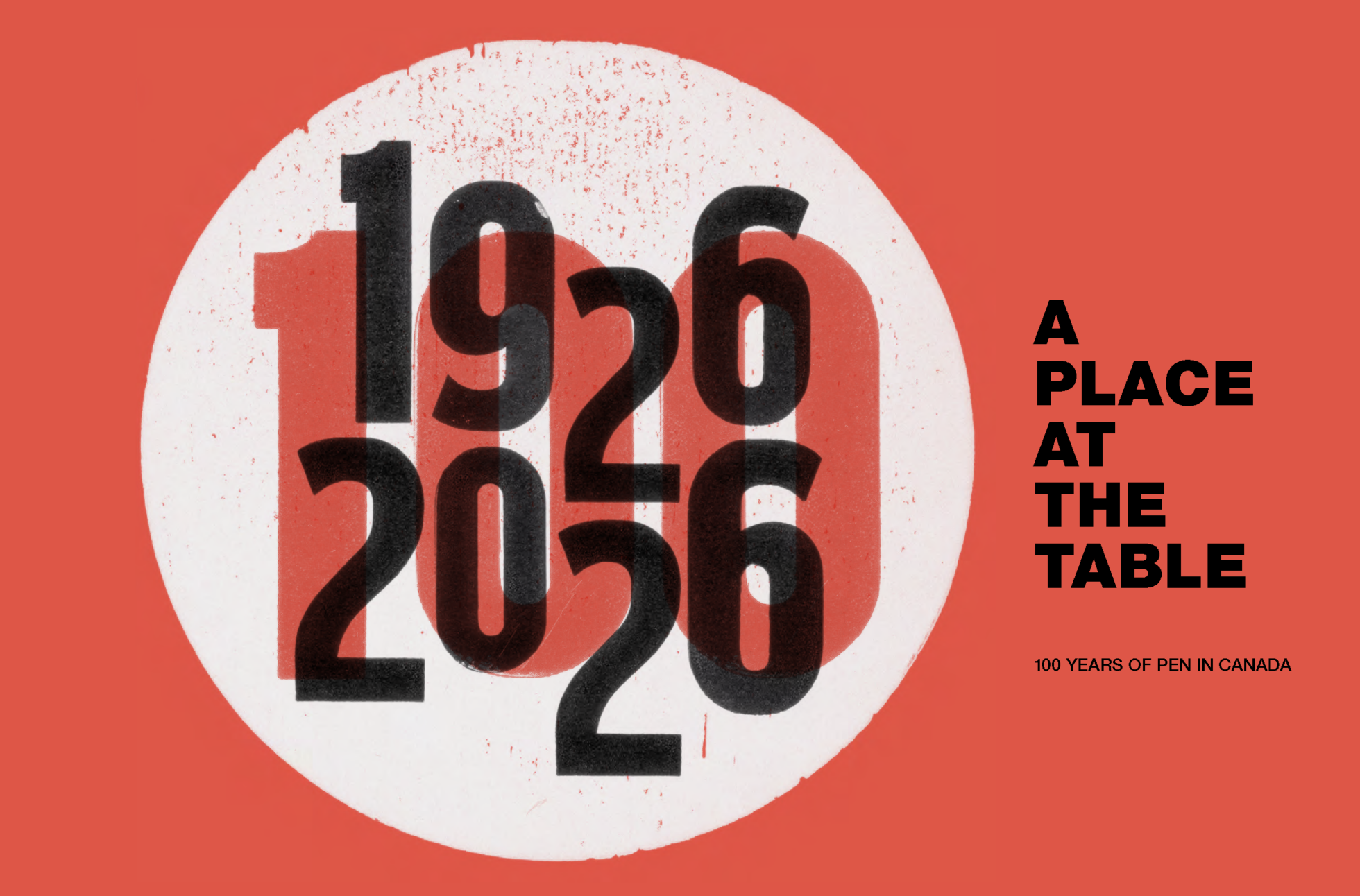
A table was where PEN Canada’s English-language story began four decades ago. It was a distinguished table—Margaret Atwood’s. The PEN Chapter in Québec, founded in 1926, had just split into francophone and anglophone centres to better serve both writing communities. Atwood and Graeme Gibson began hosting dinners for visiting writers and PEN International officials, hoping to learn from them what our own fledgling group could be. Those lively meetings evolved into a robust national organization that has advocated for imprisoned writers abroad, resettled writers in exile, and given voice to pressing questions of free speech here at home.
We reflect on that mission in this report, which highlights moments from PEN’s vibrant century in Canada, including the combustible case of Eli Langer, the artist whose work was brought to trial under new child pornography laws in the 1990s, and Jiang Weiping’s harsh imprisonment and exit from China. Long before global media turned their attention to crackdowns on diaspora dissent, the Chinese journalist resettled in Canada with PEN’s aid, only to find himself still in his former government’s sightlines.
Through the decades, PEN Canada has held the space for freedoms of imagination, expression, and thought. Sometimes this is less gentle work than it sounds. It is part of the mission of claiming space for all voices: writers who cannot write because they are imprisoned or in peril; writers who must, even if they say unpopular things their public does not want to read; writers whose books vanish from library shelves; and writers who, but for PEN’s insistent spotlight, might themselves vanish from memory—like the Eritrean-Swedish dissident Dawit Isaak, imprisoned in Eritrea since 2001, for whom PEN continues to advocate.
We speak about the necessity of a space at the table because consequential decisions happen here. So does connection, though a table is not always a comfortable place. If everybody has a voice, some disharmony is to be expected, and welcomed. For a hundred years now, writers and their champions have gathered around PEN’s table to encourage this noisy debate, to defend the written word and artistic imagination and freedom even if, or especially if, we disagree. Sara Ahmed described another function of a table. Yes, it is “a surface to write. A table: how we come to write, what we can read.” It is also a place from which to change the story
Edited by Sarmishta Subramanian
Design: soapboxdesign.com
Illustrations: tarahardyillustration.com
Contributors include José Teodoro, Charlie Foran, Adnan Khan, and Rui Umezawa, with reflections from previous presidents Margaret Atwood, Marian Botsford Fraser, Randy Boyagoda, Haroon Siddiqui, and Grace Westcott.
Read the full report.


Subscribe for updates about PEN Canada’s work to defend free expression.