Writing where silence breaks
April 29, 2026 | Onder Deligoz

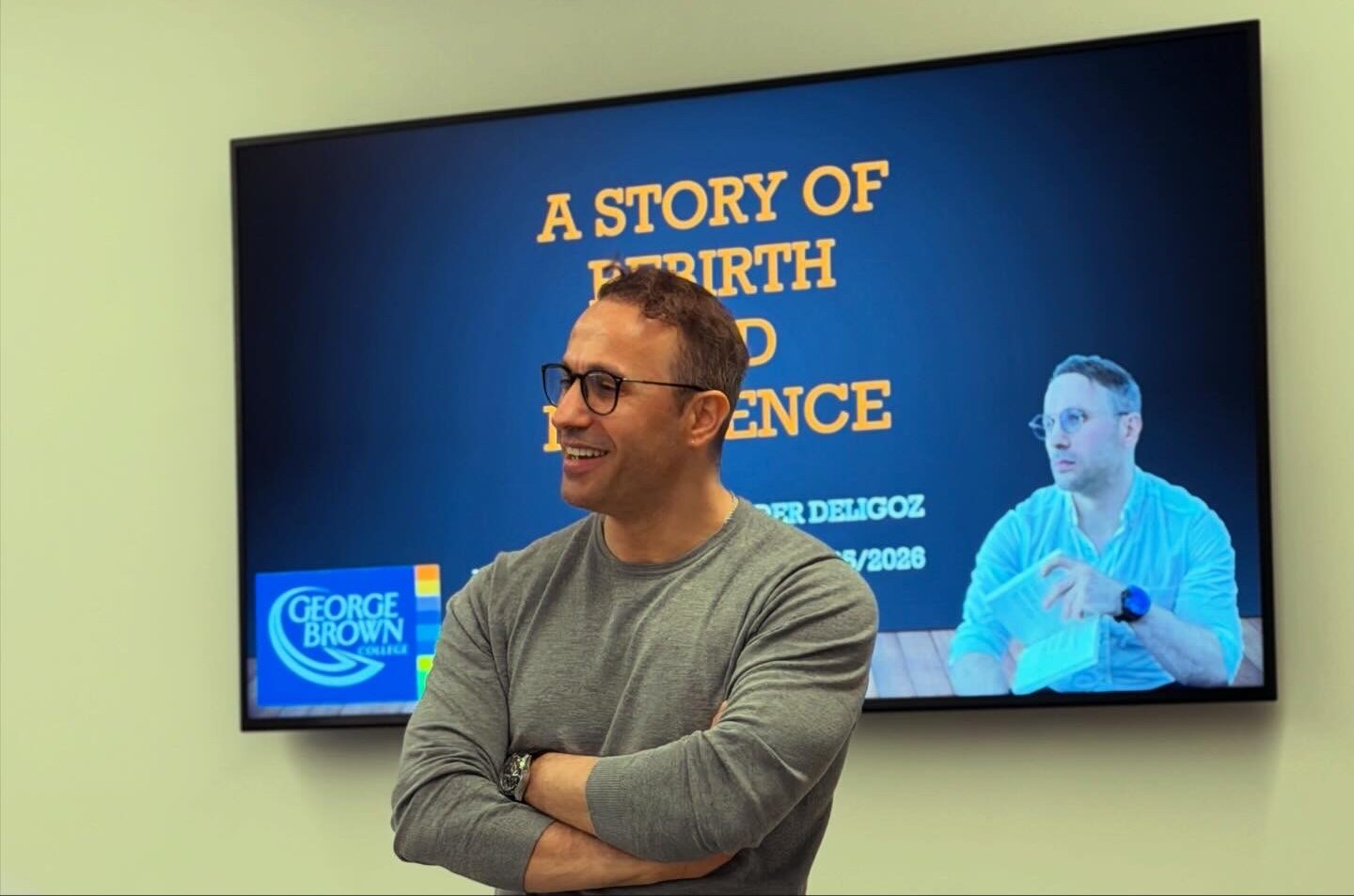
Onder Deligoz speaks with students during a classroom visit in spring 2026.
For over twenty years, George Brown College has partnered with PEN Canada to invite exiled writers into the College to discuss freedom of expression, human rights, and the importance of democracy.
This year, Onder Deligoz, a journalist and writer from Turkey, was chosen as the 2025 PEN Writer-in-Residence at George Brown College. During his residency, in between classroom visits, Onder worked on his debut poetry collection, A Mirror Reckoning.
Deligoz has worked as a reporter, editor, and editor-in-chief at national media outlets in Turkey. His reporting covered stories of human rights violations and unsolved political murders. He is a member of the PEN Canada Writers in Exile, and with his residency wrapping up in April 2026, he shares with us his reflections on his residency and the students he met along the way:
Public discourse around Gen Z often circles the claim that they are detached, framing a lack of concern for difficult realities unfolding elsewhere in the world. My year as a PEN Canada Writer-in-Residence at George Brown College suggests otherwise. They are far from indifferent. Many are deeply connected to these realities, even shaped by them. They are not distant observers, but participants, fully aware of what is happening. What they need, more than instruction, is someone who will listen.
My most meaningful exchanges did not begin in classrooms but in the hush of campus libraries or in food courts where the noise of trays contended with voices that spoke many different languages. In-between spaces, where no one was assigned to speak and no one was required to listen, where quieter conversations could arise. Here is where my residency found its rhythm.
Across two academic terms, I shuttled between these informal spaces and classrooms dedicated to several different disciplines. I spoke with students of business, health sciences, design, and technology. Many felt that writing was secondary to their studies even though it often proved essential. I tried to show that it wasn’t just there to complete an assignment, but that it could help them process experience and articulate questions, doubts and feelings that might otherwise remain unspoken.
My formal visits gradually became more fluid and my work shifted from instruction towards dialogue. Whether we met in classrooms or in shared campus spaces, our focus remained the same: how to make room for expression and for conversations that are not always easy to have. We often discussed the complexity of speaking out on difficult subjects. For many students, freedom of speech was not an abstraction, it was a daily challenge shaped by hard experience and risks. Writing became a way for them to explore this complexity, to unpack how fear and expression can coexist, how language can help to reveal something, and protect it.
I tried to show them that freedom of speech is not only about speaking up when it is easy, but about holding your nerve when speech gets restricted, delayed, or punished. In many parts of the world, people end up under oppressive governments because small violations of human rights are allowed to pass unchallenged. There is a dangerous assumption that minor injustices, small restrictions, brief silences, will remain contained. History proves otherwise. Repression rarely arrives all at once. It begins with something easily dismissed as minor or transient, a spark that is not acknowledged or “ashed,” When ignored, or normalized, however, this spark becomes a flame, it spreads beyond control until everyone is affected. This metaphor resonated with many students, especially those who had already seen, first-hand, how quickly rights and freedoms could vanish in their own community.
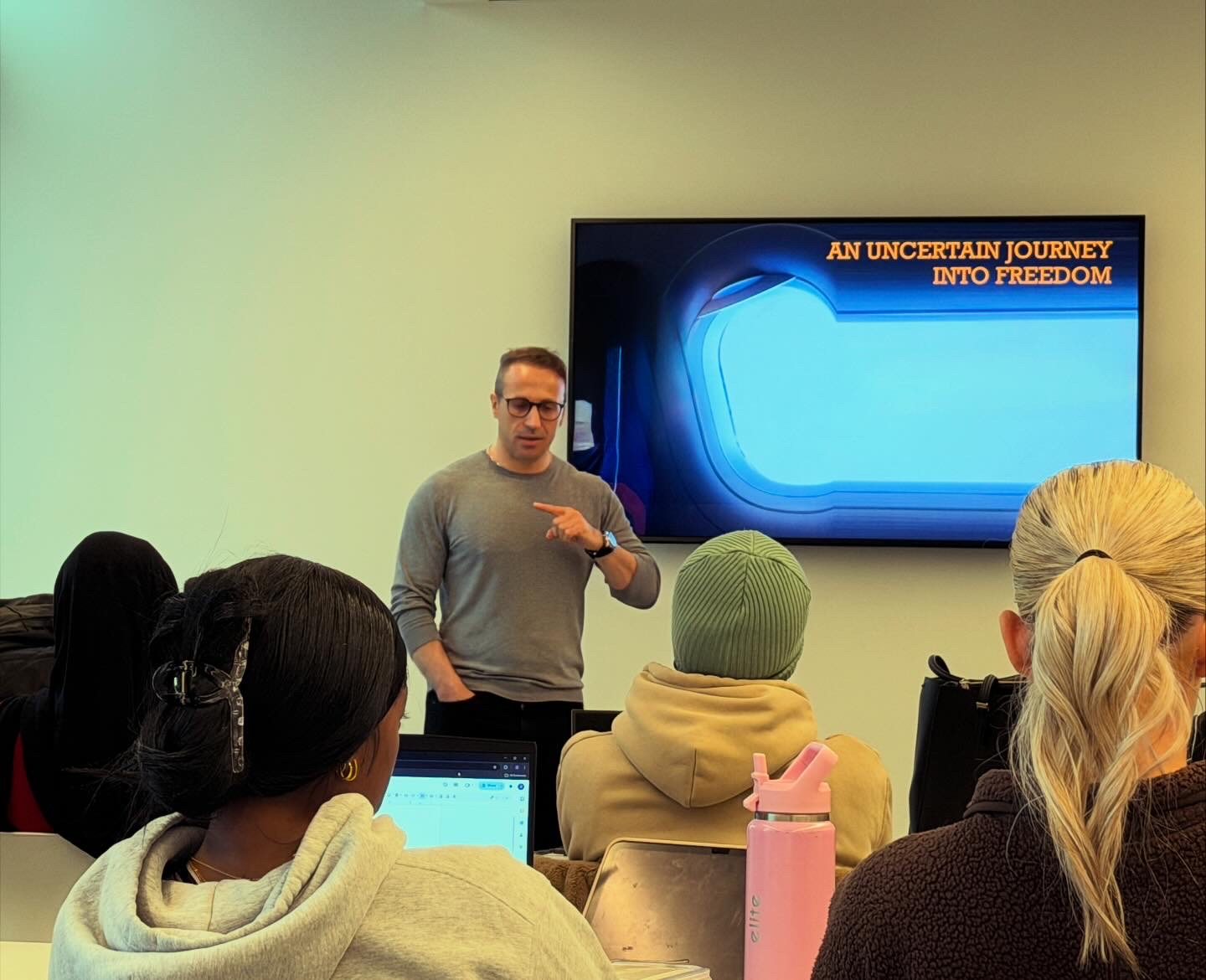
I shared parts of my own journey sparingly, not as a model, but as a point of connection. I spoke about arriving in North America and the uncertainty of rebuilding a life. Writing was not a guarantee of success, but something I refused to give up. It became a constant practice, allowing me to find a way forward even when the direction was unclear.
I emphasized a perspective that has shaped me profoundly: that resilience is not about outlasting hardships, nor about being defined by them. Resilience is persistence, it’s about getting back up after a setback, often quietly, and continuing to advance without turning your story into either a defeat or a spectacle. Writing can create distance. It allows you to shape your narrative, rather than be shaped by it entirely.
What I will remember most is not what I shared, but what I heard. Students who spoke about displacement, or leaving behind languages, or of the tension between adapting to a new culture while remaining faithful to their origins. Some shared fragments of poetry, others wrote short reflections — unsure that their words mattered. Their hesitation revealed how often such voices are minimized even before they attempt to speak. At those moments, my role was clear. I wasn’t there to validate the content, but to affirm the act. Writing, and freedom of speech, do not require permission. They require attention, honesty, and a willingness to engage with complexity.
Many students carried stories shaped by lives far beyond the college. In Iran, Myanmar, Sudan, and several countries across the Middle East. When they wrote, none of these places felt remote, they were lived realities, ever present in memory, language, and silence. Their words had weight, and so did their silences. Our exchanges began to influence my own work. As I continue developing my poetry collection, I notice shifts in how I approach voice and perspective. I have become more attentive to silence, to what it implies, and to the responsibility of writing among a polyphony of voices.
My residency did not end with a single conclusion. It bequeathed a series of ongoing conversations that remain unfinished and interconnected. What I have taken from this experience is a deeper understanding that writing does not take place in isolation. Even when done alone, it is shaped by encounters, by listening, and by the willingness to hold space for others. In classrooms, in libraries, and in food courts, writing appeared where it was needed. I arrived thinking I would be a guide. I left understanding I had also been guided — by voices that continue to shape how I write, think, listen, and move forward through this world.


Subscribe for updates about PEN Canada’s work to defend free expression.