Mirasnama: Reclaiming a Silenced Civilization Through Knowledge
July 15, 2026 | Mayyu Ali

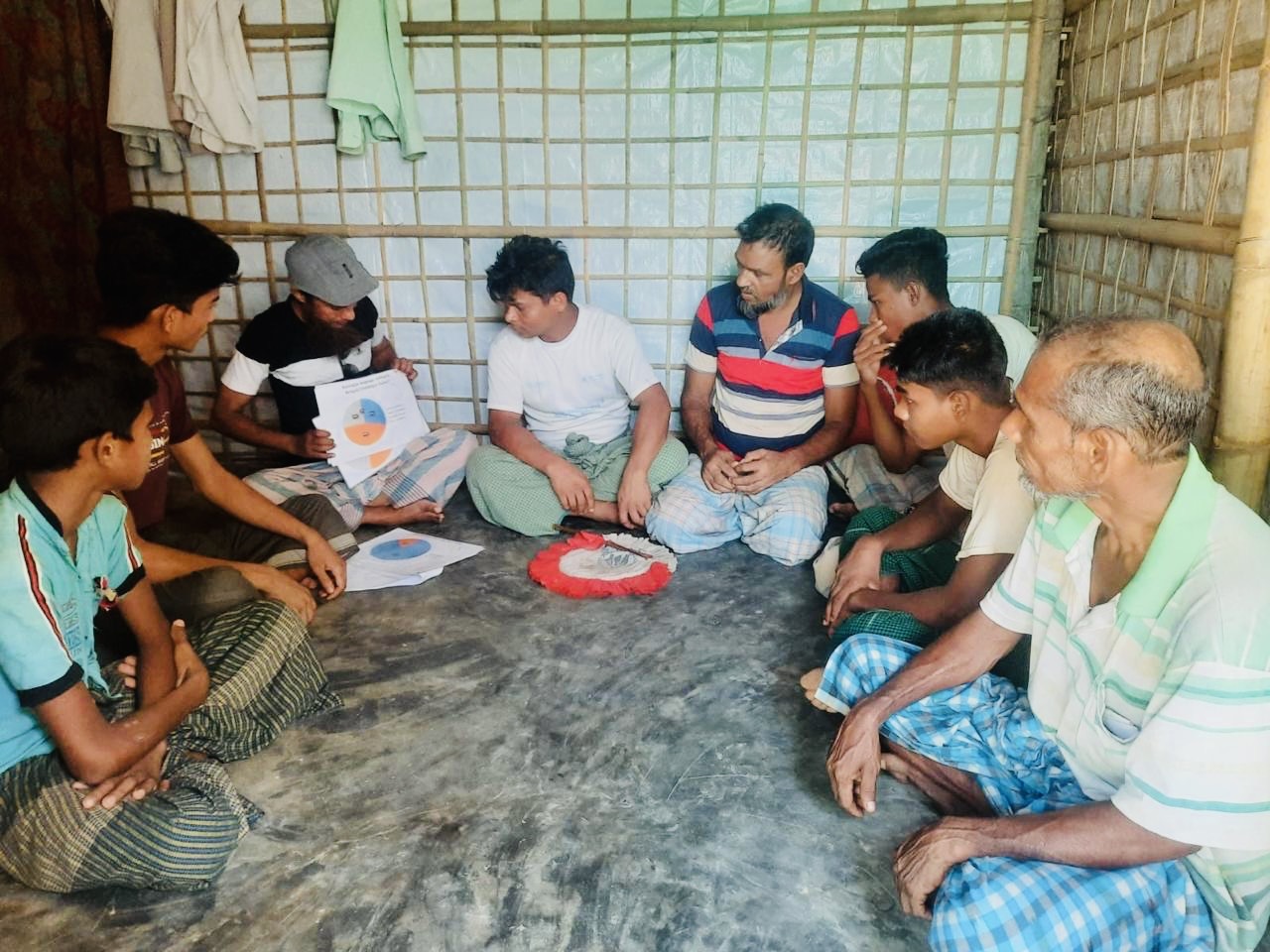
Photo: In 2020, A team member of Rohingya language preservation project is conducting a community awareness session on the importance of preservation of Rohingya language and culture inside a shelter in a refugee camp in Cox’s Bazar. The project was directed by Mayyu Ali.
Based in Ottawa, Mayyu Ali is a Rohingya-Canadian poet and author. He fled Myanmar during the genocidal violence carried out by Myanmar military regime against the Rohingya in August 2017. In 2021 he was resettled in Canada, and went on to earn a Master of Arts in Global Governance from the University of Waterloo.
Mayyu is the founder and director of Rasa Books, a multilingual Rohingya publishing house producing fiction, poetry, history, biography, cultural and children education books in Rohingya, Burmese, and English. As Rasa publishes the final book in a trilogy of comprehensive Rohingya oral traditions, Mayyu tells PEN about about the richness of this culture and literature.
In an age marked by escalating conflict and war, human knowledge itself is increasingly endangered. Too often, the world comes to know persecuted and marginalized communities only through the lens of crisis—at a point when their histories have already been fractured, their identities distorted, and their ways of life disrupted. What we encounter in humanitarian reports or media narratives is rarely the full truth of who these communities are. We do not see them as they once were—grounded in dignity, guided by values, and flourishing in peace. We miss their intellectual traditions, their moral philosophies, and the everyday beauty of lives lived without fear.
This gap in understanding is especially evident in the case of the Rohingya. Through years of humanitarian engagement in Myanmar and Bangladesh, I have worked alongside many dedicated international colleagues striving to respond to the crisis. Yet, as a member of the community—as an interpreter, activist, and writer—I have often found it difficult to convey the true essence of my people. To do so, I return to memory: to a time when our ancestors built a civilization with a shared kingdom, a structured court system, maritime trade, agriculture, literature, culture, and language. These recollections are not nostalgic indulgences; they are essential frameworks—living archives that reveal the humanity, coherence, and cultural richness of a people too often reduced to suffering.
The Rohingya are an Indigenous people of Arakan, descendants of a civilization that contributed profoundly to the region’s history during the Mrauk U Dynasty (1430–1785). Our ancestors were not only farmers and traders but also poets, scholars, interpreters, and court officials. Figures such as Abdul Karim Khodkhar, author of Dulla Majlis, Tamim Ansari, and Hazar Masail, exemplify a vibrant literary and intellectual tradition that flourished in Arakan. As the renowned court poet Sayyid Alaol once wrote, “Muslims of Rosanga (Rohingya) were patronized as seekers of knowledge, as trainers in the art.” This legacy defines the Rohingya not merely as survivors, but as a people historically rooted in knowledge production and cultural expression.
Today, however, the Rohingya are subjected to a systematic campaign of genocide by the military regime in Myanmar. While the physical violence is widely documented, a more insidious loss often goes underexamined: the erosion of language, culture, and identity. These are invisible wounds—unquantifiable in legal frameworks yet devastating in their long-term impact. As communities struggle daily for survival, the gradual disappearance of their cultural soul risks going unnoticed, even from within.
It is in response to this erasure that Mirasnama emerges as a vital intellectual and cultural intervention. Between 2020 and 2022, I led the Rohingya Language Preservation Project of Community Rebuilding Centre in the refugee camps of Cox’s Bazar, followed by the publication of the research report “First They Targeted Our Culture and Language” in 2023. From 2022 to 2024, our team documented and compiled over 5,000 pieces of Rohingya oral traditions—including proverbs, riddles, folktales, and folksongs—preserved across generations through memory and voice.
Mirasnama—meaning “legacy” in Rohingya—is a historical series of comprehensive collections of Rohingya oral traditions. Through Rasa Books, these traditions are now being published as part of Mirasnama. The first three volumes—BOSON: Rohingya Proverbs, SÓLLÚK: Rohingya Riddles, and TARANA: Rohingya Folksongs—mark a historic milestone. For the first time, both the Rohingya community and a global audience can access these bodies of knowledge in written form. What was once carried solely through oral transmission now stands preserved in print—an enduring testament against the forces that sought its extinction.
BOSON: Rohingya Proverbs is a comprehensive compilation of 200 Rohingya proverbs, presented in Rohingya, Burmese, and English. Rohingya proverbs are an integral part of the oral tradition of Rohingya culture, transmitting through oral traditions from generation to generation within the community. They are composed in the native Rohingya language, rich in rhythmic verse rooted in history and the spirit of land. They convey knowledge, provide counsel, reinforce moral values and inspire individuals, serving as guiding principles that foster community life and enhance social cohesion. This is a collection of preservation of Rohingya language, culture, and identity.
SÓLLÓK: Rohingya Riddles is a comprehensive compilation of 100 Rohingya riddles, presented in Rohingya, Burmese and English. Rohingya riddles are an integral part of the oral tradition of Rohingya culture, transmitting through oral traditions from generation to generation within the community. They are composed in the native Rohingya language, holding significant cultural, intellectual, and spiritual importance. These riddles often use metaphors and symbolism to represent abstract ideas, spiritual concepts, or aspects of the human condition, and are performed in groups, serving as a means to assess a person’s intelligence, wisdom, and knowledge. This is a collection of preservation of Rohingya language, culture, and identity.
TARANA: Rohingya Folksongs is a comprehensive compilation of 60 Rohingya folksongs, presented in Rohingya, Burmese and English, accompanying each folksong with illustration and background explanation. Rohingya folksongs are an integral part of the oral tradition of Rohingya culture, passed down from generation to generation within the community. Composed in the native Rohingya language, they serve as vital cultural pillars that preserve history, oral traditions, and community identity across generations. They mirror societal values, struggles, and hopes while fostering social cohesion and continuity with the past. Often anonymous and shaped for collective participation, these songs strengthen a shared sense of belonging through simple melodies and evolving forms. They also serve as oral records of Rohingya ancestors, capturing ways of life, the spirit of the land, war, natural calamities, and more. This compilation is a collection dedicated to preserving the Rohingya language, culture, and identity.
WE ARE ROHINGYA: A Celebration of Rohingya Culture and Identity is a children illustration book. Discover the rich history of Arakan, its ancient dynasties and kingdoms, and learn about the Rohingya people, their ancestors, and their way of life. Explore Rohingya cultural identity, symbols, customs, music and songs, cuisine, traditional arts and crafts, and much more. Every page of the book is accessible, visually stunning, and filled with inspiration for young minds. Perfect for parents, educators, and caregivers, this book opens the door for children to explore new worlds of culture, tradition, and belonging.
The significance of these works extends beyond literary preservation. Mirasnama acts of defiance. They reclaim a narrative long overshadowed by violence and restore a vision of the Rohingya grounded in intellect, ethics, and cultural continuity. They challenge policymakers, researchers, and humanitarian actors to engage with the Rohingya not only as victims of crisis, but as bearers of a sophisticated and enduring knowledge system.
Due to the ongoing persecution by the Myanmar military regime, the majority of the Rohingya population has been displaced from their homeland and is now scattered across different countries and continents. For the sons and daughters of Arakan born in the diaspora, Mirasnama offers a vital connection to their roots—a vessel of ancestral knowledge, wisdom, and philosophy through which land and life remain connected, even from afar.
For those seeking to understand the Rohingya more deeply, Mirasnama provides an essential entry point. It invites readers to engage with the community through its own epistemology—its ways of knowing, teaching, and imagining the world. Such understanding is not merely academic; it is foundational to any meaningful engagement with the complexities of the Rohingya crisis.
The genocide against the Rohingya continues. Displacement persists, and within Myanmar, language, stories, and cultural expression remain under threat. Yet through these volumes, something powerful endures. The knowledge that was meant to be erased has been written, preserved, and shared. In reclaiming their voice, the Rohingya assert not only their survival, but their rightful place in the intellectual and cultural history of humanity.
Mayyu Ali is a Rohingya-Canadian poet and the author of Exodus, The White Elephant, and Eradication. His op-eds have appeared in major international outlets, including The New York Times, The Washington Post, Time, The Guardian, The Independent, CNN, and Policy Options. He fled Myanmar during the genocidal violence carried out by Myanmar military regime against the Rohingya in August, 2017. In 2021, he was resettled in Canada. In 2024, he earned a Master of Arts in Global Governance from the University of Waterloo. He is the founder and director of Rasa Books, a multilingual Rohingya publishing house producing fiction, poetry, history, biography, cultural and children education books in Rohingya, Burmese, and English. He currently resides in Ottawa.


Subscribe for updates about PEN Canada’s work to defend free expression.