In an Era of Book Bans, this Organization is Giving Them Away
March 30, 2026 | PEN Canada

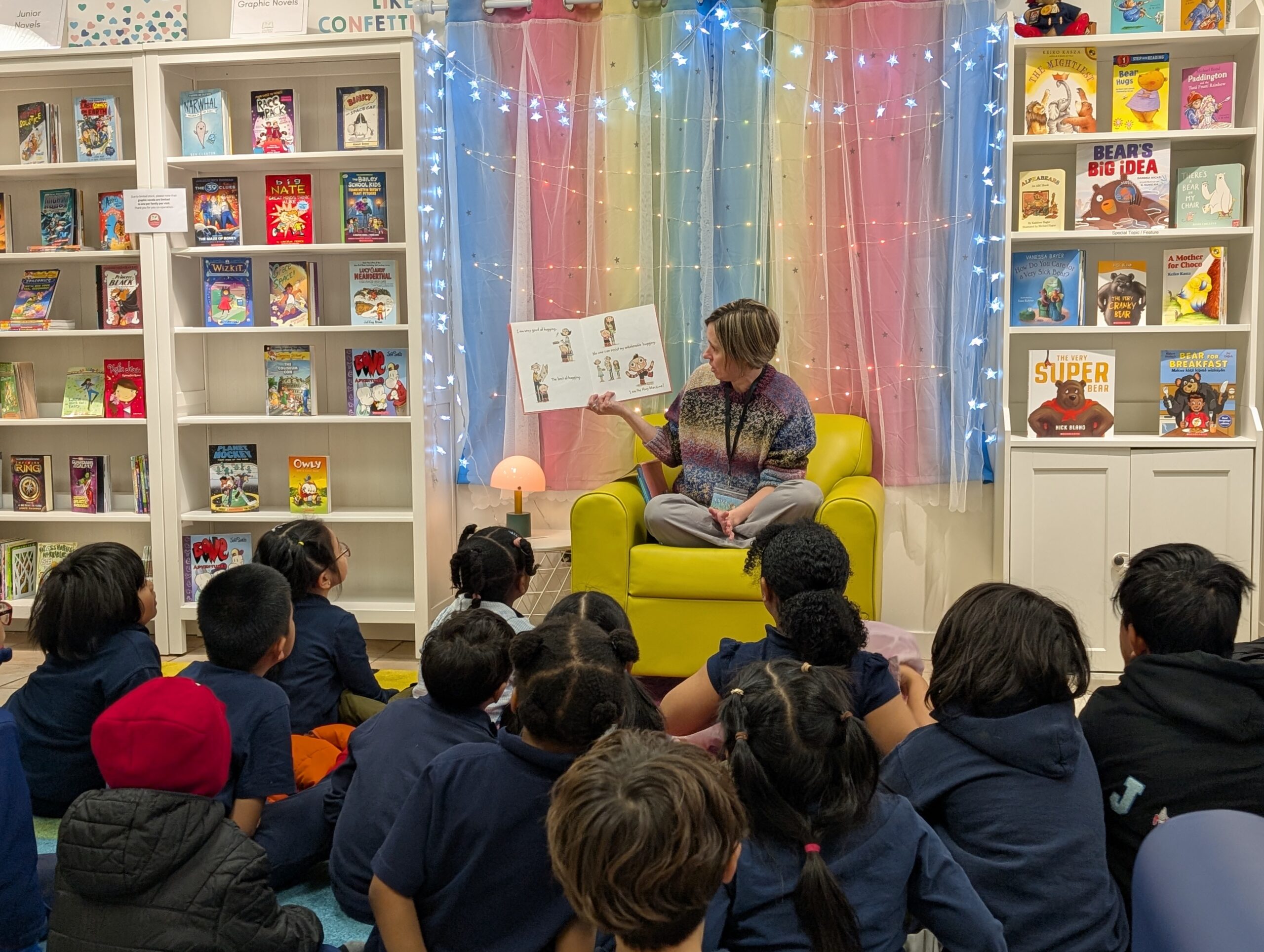
Luiza Junqueira at the Children’s Book Bank.
At a moment when many special interest groups, governments, and educators are devoted to keeping some books out of children’s hands, there is something almost radical about an organization devoted to getting books into the hands of children.
The Children’s Book Bank provides free books and literacy programs to children across Toronto. The idea could not be simpler: parents and children can stop by one of four locations, engage with age-appropriate programming (story hours, teen clubs, and so on), and take a book home for free, no strings attached. No registration, no fees, no membership, no ID required: just a free book. People from anywhere on earth can pop in and leave with a book for their child.
In 2024, the Children’s Book Bank gave away 146,632 donated books to children in need. Since 2008, they have distributed 1.9 million books across the city.
PEN Canada President Ira Wells recently interviewed Luiza Junqueira, manager of the Jane & Finch location of the Children’s Book Bank, to learn more. Their conversation has been edited for length and clarity.
Ira Wells (IW): Tell us about the origins of the Children’s Book Bank.
Luiza Junqueira (LJ): In 2008, a group of founding members, all of whom were involved in literacy and education, came together to address gaps they were noticing in the education system. They’d noticed how hard it was for some kids to access books, especially in underserved communities. We started in a townhouse on Berkeley Street in Toronto and now have four locations across the GTA.
IW: So, children can just walk in and pick up a book?
LJ: We limit to one book per person, including the grown-ups. In the past it was one book per kid, but we noticed that sometimes a child would choose a book, and then the parent would push them to choose something else.
IW: Like, something more educational?
LJ: Exactly. So now, their grown-up can pick a book, and the kids can pick Dogman or whatever they want.
IW: Why is it important for kids to own these books?
LJ: By choosing books, kids can start building libraries of their own. This helps create a home environment that encourages reading, thinking, and sharing stories. Sometimes kids develop a powerful bond with a book—the characters become part of who we are. Sometimes, especially when kids are in distress, books can become a comfort. And once a book is in a family’s library, it can be passed on. It’s beautiful when you hear that an older sibling got a book from us, and is now passing it along to a newborn.
IW: There is something special about passing on books that have really meant something to us. It’s like a window into ourselves.
LJ: Right! Or, you bring a book to school and give it to your best friend. It helps kids build relationships around books.
IW: How do the children respond?
LJ: In different ways. I remember one little boy, a newcomer with a very strong accent, who said ‘This is my first book in English. When do I have to give it back?’ And I said: Never. It’s yours. And he just gave me a big hug.
IW: Are the books new or used?
LJ: The books are donated by publishers or by the community. The books on our shelves either are new or look new. There’s nothing wrong with used books, but some of our children are coming from situations where it’s nice for them to be able to choose something new—it brings a small sense of pride and dignity.
IW: And you also arrange author visits? Why is it important for children to hear directly from authors?
LJ: Sometimes, kids tell me, ‘I could never be a writer, look at me.’ They say, ‘books are for smart people.’ Author visits can help kids see a different future. We try our best to invite authors that are from different backgrounds, different religions, different points of view. Especially for kids who may be refugees, it can be powerful when we host an author who is in exile or who has fled a difficult situation, and who has found success in Canada. It allows them to realize that, to be successful, conditions do not have to be perfect from the start.
IW: You happen to be doing this work—getting books into the hands of children—at a moment when many in our society are devoted to the opposite, in keeping some books out of children’s hands. Why do you think we are seeing this surge in book banning?
LJ: I think people are just… I don’t know, I think everybody’s confused, and overwhelmed, and scared. People want to control how children think. They want to control the narrative. Stories are powerful, right? Because if you start understanding other points of view, you might start questioning things, questioning how things can be done differently. It’s about control.
IW: Reading to my own children has certainly been one of the most profoundly meaningful and nourishing parts of my life. Can you describe the power of reading to kids?
LJ: The connection is magical. When they’re really young, and you’re reading to your own child, there’s the cuddling part—you feel so close together. As they grow, there is the sharing of stories and seeing it through someone else’s eyes and, more often than not, through more naïve, innocent eyes that bring out points of the story you wouldn’t have seen.
IW: What does the Children’s Book Bank make possible? What do the stories and narratives the children access through your services mean to your patrons?
LJ: For starters, by sharing stories, we not only connect to each other, but we better understand ourselves. For patrons who may be refugees or coming from traumatic situations, stories can help them cope—it’s that sense of, I’m not in this alone, other people have been through this. So the book can become a companion of sorts.
IW: For those of us who care about reading, about literacy, about supporting this work—how can we help?
LJ: There are couple of ways. The easiest way is they can donate gently used books, books your children may have outgrown. Also, schools and organizations can do a book drive for us. And we rely upon volunteers to read stories, maintain our spaces, and process books. All that information is on our website.
IW: Thank you for your important work.
LJ: Thank you for speaking to me!
For more information, visit the Children’s Book Bank on the web.


Subscribe for updates about PEN Canada’s work to defend free expression.