Q&A with Basima Takrouri, winner of the 2026 PEN-Humber Writer-in-Exile Scholarship
October 16, 2026 | PEN Canada

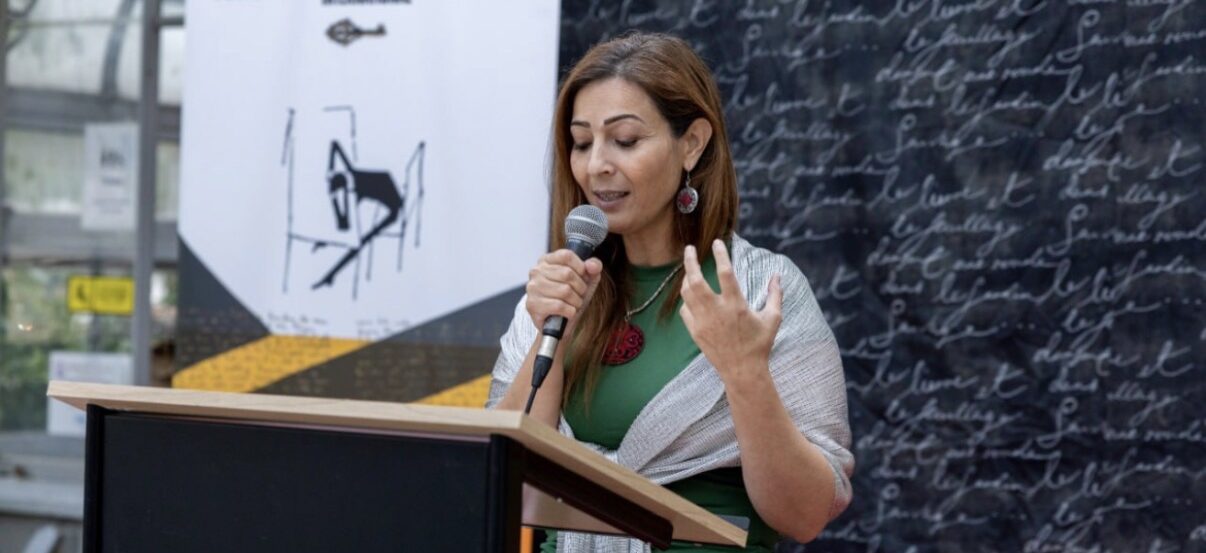
“I wanted to write about what happens when exile gets old.”
Basima Takrouri, a Palestinian-Canadian writer, is the recipient of the 2026 PEN-Humber Writers-in-Exile Scholarship. The scholarship covers the cost of the Creative Writing graduate certificate at Humber Polytechnic, a year-long course that offers one-to-one mentorship with a professional writer while the recipient works on an unpublished book-length project.
She received the scholarship for her new satirical novel, Toronto Finger, which follows the story of an exiled writer who has lived in Canada for 40 years. It’s an English-language novel exploring memory, exile, class, and the persistence of the past in the life of an aging, forgotten immigrant writer.
Two months into her year-long writing project, PEN caught up with Basima about what this scholarship means for her project, and the story behind the novel:
You are a Palestinian-Canadian writer, filmmaker, and cultural producer from Jerusalem. Talk to me about the literary and arts culture you grew up with. How does this identity and culture shape your craft, and the literary communities you now work with?
I grew up in Jerusalem, and I think Jerusalem teaches you very early that there is never only one version of a story. The same street can have two names, the same place can carry completely different memories, and history is not something you only read about. It is around you all the time.
I read a lot growing up. Arabic and Palestinian literature were naturally a part of that, but so were translated novels, cinema and theatre. Later, working in film and cultural production changed the way I wrote as well. Film taught me to see scenes, to listen to dialogue, and perhaps most importantly, to pay attention to what people don’t say.
I don’t consciously sit down and decide to write as a Palestinian or an Arab woman. These things are already there. They are in my relationship with language, humour, memory, family, religion, politics and place.
Living in Canada since 2017 has added another layer. I now work between Arabic and English and between different literary communities. That in-between space has become very important to my writing and also to the cultural work I do here.
As part of your Humber scholarship, you’ll be working with a mentor on your unpublished manuscript, Toronto Finger. Were there any life experiences that inspired you to write this book?
Yes, although the novel is not autobiographical. After coming to Canada, I became interested in what happens to immigrants after the part of the story we usually hear about. We hear a lot about arrival and starting over. But what happens 20, 30, or 40 years later? What happens to the person you were before immigration?
I have met highly educated people doing work that has nothing to do with their education or with the lives they had before coming here. Sometimes you meet someone in a very ordinary setting and slowly discover this extraordinary previous life behind them. That stayed with me.
The protagonist of Toronto Finger has been in Canada for almost 40 years and has spent much of that time working in a store. But that is only the visible version of him. He had another life, and in his mind that life never completely ended.
I think that gap—between the person the world sees and the person someone remembers being—is where the novel really began for me.
The protagonist of Toronto Finger is an aging man who immigrated to Canada. Why did you choose to write about exile from this perspective?
I wanted to write about what happens when exile gets old. We usually encounter the immigrant at the moment of leaving or arriving. I wanted to skip forward: he works, he pays his bills, he knows the city. Nothing about his daily life looks temporary anymore. Is he still in exile?
My protagonist would probably say “yes”.
Age also changes the relationship between memory and reality. Sometimes the life behind you becomes more vivid than the one happening around you. And there is something heartbreaking, but also funny, about the difference between how the world sees this aging man working in a store and how he sees himself.
To everyone else he may simply be an old immigrant. In his own story, he is still a writer. He has loved, failed, dreamed, argued, written. He remembers being important to people who no longer exist in his Canadian life.
I wanted to write about that man.
The novel firmly sets itself in Canada, evoking place and setting with the “Canadian ceiling” or “Canada slept beneath its false whiteness.” Ultimately, these cold, white objects lead the narrator to state he never loved the country. Talk to us about the role of setting in writing and this protagonist’s reality.
Snow fascinated me when I first came to Canada. It still does. There is something almost dishonest about how completely it can cover a place. Everything becomes clean and white for a while, although nothing underneath has actually disappeared.
So when I wrote “Canada slept beneath its false whiteness,” I wasn’t only thinking about winter.
The narrator has a complicated relationship with Canada. He says he never loved it. I don’t know that I completely believe him. He has spent most of his adult life there. You don’t live somewhere for 40 years without developing some kind of relationship with it, even if that relationship includes resentment.
I am interested in that contradiction. Canada gave him a life, but it also is the place where another version of his life slowly disappeared.
Setting, for me, has to do more than tell us where the character is standing. Toronto, the store, the apartment, the snow—they become part of the way he experiences himself. Sometimes he is looking at Canada. Sometimes Canada is forcing him to look at himself.
You’ve published books before, and your debut novel, The Imam, Tale of the haunted roads, was written in Arabic and later translated into English. Why did you choose to write Toronto Finger in English first? Are there any differences in your creative process when writing an English-language novel?
I don’t think I actually sat down and made a formal decision that Toronto Finger would be an English novel. It came to me in English.
The Imam belonged to a Palestinian world that I heard in Arabic. Its characters spoke Arabic in my head. Its humour, religious language, family relationships—all of that came naturally to me in Arabic.
Toronto Finger was different. It was born in Canada, and English belonged to its setting. But Arabic never really disappears from the book. Sometimes I write an English sentence and know exactly what Arabic sentence is sitting underneath it.
There is also a difference in how I write in the two languages. Arabic comes with a very long emotional and literary history for me. I am probably more instinctive in Arabic. English gives me a little distance, and sometimes that distance is useful, especially with humour and satire.
After translating The Imam myself, I also stopped thinking of the two languages as completely separate. Writing between them has become part of the work itself.
Toronto Finger provides insights and satirical commentary of the publishing industry in Canada, including Arab publishing which you’ve worked in. Talk to me about genre and using satire to discuss experiences you’ve taken inspiration from.
Publishing is very easy to satirize. Writers are easy to satirize too, including ourselves.
We talk about literature in very serious terms—and I do take literature seriously—but the world around books can be wonderfully absurd. There is ego, money, competition, gatekeeping, literary status, people pretending to have read books they haven’t read. Arab publishing has its own absurdities. Canadian publishing has others.
Because I have worked in publishing and cultural production, I know some of those situations from the inside. Of course, fiction gives me the freedom to distort them. I can take something I have seen, combine it with something completely unrelated, exaggerate it and give it to a character who doesn’t exist.
Satire is useful because it lets me say something serious without standing over the reader explaining what the serious thing is.
And I don’t particularly like writing Palestinians or immigrants as permanently tragic people. People joke in terrible circumstances. Sometimes they become funniest exactly when life is at its worst. That feels much more truthful to me.
As part of your Humber scholarship, you’ll be working with a writer-mentor over the course of a year. Talk to me about mentorship. Who are the teachers or mentors that have shaped you so far? And which of their works would you recommend we read or watch?
I have had teachers in the traditional sense, but many of my most important teachers were writers I never met.
I grew up reading Palestinian literature, and I still return to it. Ghassan Kanafani is one of those writers. I would recommend Returning to Haifa, not only because of what it says about Palestine, but because of how much he manages to do in such a small space.
Mahmoud Darwish shaped my understanding of what language can carry when place itself becomes unstable. Edward Said’s writing on exile gave me another vocabulary for questions I had already been living with.
I also return to Jabra Ibrahim Jabra, Emile Habibi and Sahar Khalifeh for very different reasons. Habibi, especially, reminds us that irony and absurdity can carry enormous political weight.
Film has been another teacher. Working in film taught me that a character doesn’t always need to explain herself. A gesture, an object or a silence can sometimes do more work than a paragraph.
That is also what I hope for from mentorship. I don’t want someone to teach me their way of writing. I want someone who reads closely enough to understand what I am trying to do, and who is willing to tell me when I haven’t done it yet.
What do you hope to achieve through the Writers-in-Exile scholarship?
First, I want to make Toronto Finger a better novel.
There comes a point with a manuscript when you have lived with it for so long that you stop seeing certain things. You know why a scene exists, so you assume the reader knows too. You become attached to sentences that perhaps shouldn’t survive the next draft.
That is why I am excited about working closely with a mentor. I want someone who will challenge the manuscript, including the parts I am most certain about.
But the scholarship also gives me something I haven’t often had: sustained time and support to concentrate on my writing in English and to develop as a novelist within the Canadian literary community.
I don’t want the novel to become safer or more conventionally Canadian through that process. I hope the opposite happens. I want it to become more precise, more confident and more itself.


Subscribe for updates about PEN Canada’s work to defend free expression.