Between Tehran and Toronto: Atefeh Khademolreza on community, writing, and her Humber scholarship
June 15, 2026 | PEN Canada
“Resistance is not always loud; sometimes it is the quiet determination to tell the truth, preserve memory, and imagine a different future.”
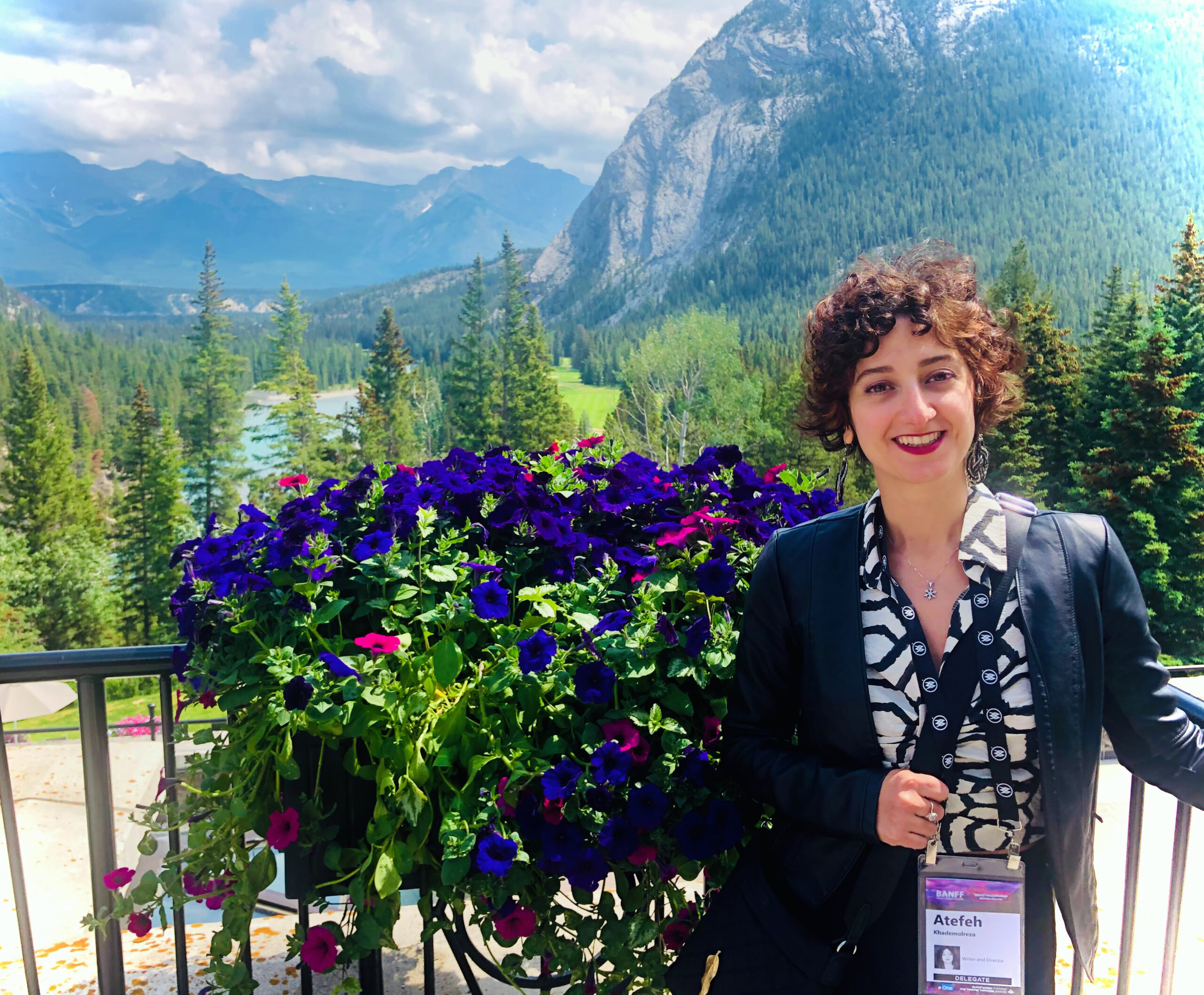
These are the words of Atefeh Khademolreza, a writer, director, and animator.
Last year Atefeh was awarded the Humber – PEN Writers-in-Exile Scholarship, which covers the cost of a graduate certificate program in creative writing. While at Humber and under the mentorship of novelist and critic Antanas Sileika, Atefeh worked on her debut novel, A Grizzly Bear in Tehran.
The novel follows a young woman who dreams of becoming a journalist under a repressive regime. The woman’s journey is marked by quiet defiance and everyday acts of courage as she navigates a system that seeks to silence her. Atefeh says it is a work of fiction drawn from lived experience, and considers the novel “a personal act of resistance and a testament to what it means to create under pressure.”
Now at the end of her Humber scholarship, we caught up with Atefeh who speaks on creating across borders, Persian poetry and films, and “living between worlds”:
PEN: You describe A Grizzly Bear in Tehran as a “personal act of resistance.” Tell us about the genesis of this novel, and which acts of resistance around the world have inspired your work.
I began writing A Grizzly Bear in Tehran nearly a decade ago as a way to make sense of the contradictions I carried with me from Iran to Canada. Even before I left Iran, I was fascinated by the gap between who we are privately and who we are allowed to be in public. After immigrating, those questions stayed with me. I found myself thinking about censorship, self-censorship, and the ways political systems shape our inner lives.
The novel follows a young journalist in Tehran navigating surveillance, desire, shame, and the struggle to remain truthful in a society that demands silence. Writing it has become a way of examining my own relationship to freedom: what it means to speak honestly, to imagine without fear, and to reclaim parts of myself shaped by years of censorship.
I have been profoundly inspired by the courage of Iranian women and by the Woman, Life, Freedom movement, as well as by writers, artists, and ordinary people who continue to resist through acts of memory, creativity, and truth-telling. Their resilience reminds me that resistance is not always loud; sometimes it is the quiet determination to tell the truth, preserve memory, and imagine a different future.
Your formal education spans two continents and two very different creative cultures: both a bachelors and masters degree from Sooreh University in Tehran, and an MFA in film production from York University in Toronto. How did your formal training on each side of that divide shape you?
My education in Iran and Canada taught me very different lessons, and I carry both with me in my work:
At Sooreh University in Tehran, I learned how to create within limitations. Political, financial, and cultural restrictions forced us to think creatively about how films and visual stories could be told. Whether we were making short films, writing screenplays, or developing animation projects, we often had to find indirect ways of expressing ideas, knowing that certain subjects or criticisms could not always be addressed openly. I was influenced by Persian literature and poetry, particularly writers such as Sadegh Hedayat, Ahmad Shamloo, Sohrab Sepehri, Abbas Maroufi, Zoya Pirzad, and Ebrahim Golestan. Their work taught me that storytelling can communicate through metaphor, symbolism, and multiple layers of meaning. Often, what could not be said directly became the most interesting part of the work.
York University offered me something equally important: the freedom to experiment without fear. Through the MFA program, I was encouraged to question assumptions, take artistic risks, and develop my own voice. For the first time, I could explore ideas openly rather than translating them into coded language.
Together, these two education institutions shaped me as a filmmaker and writer. Iran taught me how to find meaning beneath the surface, while Canada taught me the value of speaking more directly. My work exists somewhere between those two traditions.
In addition to being a member of the PEN Canada Writers in Exile, you’re a founding member of the Association of Iranian Film and Theatre Artists Abroad (AIFTAA), a collective of Iranian artists living in exile around the world. What is the role of community in sustaining your creative practice in exile?
Community is essential to my creative life in exile. Living far from Iran can sometimes be isolating, especially when so much of my work is rooted in the people, culture, and experiences I left behind. Organizations like PEN Canada and AIFTAA remind me that I am not carrying those stories alone.
They create spaces for connection, support, and conversation with people who understand the complexities of displacement and belonging. As a founding member of AIFTAA, I have also seen how important it is for artists in exile to create spaces for one another. Community helps preserve cultural memory, strengthens creative resilience, and reminds us that even when we are scattered across the world, we remain connected through storytelling and art.
What have you learned from collaborating with other Iranian artists in exile, and how do those shared experiences inform your own work?
Collaborating with other Iranian artists in exile has reminded me that we carry different memories, political views, identities, and relationships to the country we left behind. At times, those differences can be challenging, but they have taught me to listen more carefully and embrace complexity. Working alongside other Iranian artists has continually challenged and enriched my understanding of identity, belonging, and home.
You trained under the late Abbas Kiarostami before immigrating to Canada. Tell us more about your artistic influences from film and literature. And how does your filmmaking influence the way you approach writing fiction?
Growing up in Tehran, I was shaped by both Iranian cinema and literature. Studying with the late director and screenwriter Abbas Kiarostami had a profound influence on me. Films such as Where Is the Friend’s House? and Close-Up taught me to trust simplicity and find meaning in small details.
What inspired me most about Kiarostami’s work was his relentless search for truth and authenticity. He taught me that powerful stories can emerge from the simplest situations and that ordinary lives contain extraordinary depth. He focused on the poetry of everyday life and the emotional truths hidden within seemingly ordinary moments. He often worked with minimal crews and simple tools, always striving to get closer to the essence of human experience.
Kiarostami believed that art should take us beyond the surface of reality and lead us toward deeper truths that are emotional, spiritual, and profoundly human. He taught me that there is beauty and meaning in places many people overlook, and that some of the most powerful stories emerge from observing life with patience, curiosity, and compassion.
I was also deeply influenced by Bahram Beyzai, the filmmaker and playwright. What stayed with me most was the way he created complex, intelligent, and active female characters who shaped their own destinies. Characters such as Tara in The Ballad of Tara challenged many of the traditional roles assigned to women and expanded my understanding of what storytelling could be. His work showed me that women could be the driving force of a story, not simply observers of events.
In literature, Simin Daneshvar’s novel Savushun left a lasting impression on me. What moved me most was the way she portrayed an ordinary woman navigating a society shaped by political upheaval and social expectations. Daneshvar showed how courage can emerge in quiet and unexpected ways. Her work helped me understand that political stories are ultimately human stories.
Forough Farrokhzad’s poetry, particularly Another Birth, influenced me in a different way. Her voice was fearless, intimate, and personal. She wrote about inner life, desire, loneliness, and freedom with remarkable honesty. Reading her taught me that vulnerability can be a source of strength and that personal expression can carry profound social and political meaning.
Gabriel García Márquez, especially through One Hundred Years of Solitude, expanded my understanding of how literature can blend the ordinary and the extraordinary so seamlessly that the surreal feels completely real. I love the way his work moves effortlessly between history, memory, myth, and everyday life, revealing deeper emotional and human truths through a style that is both poetic and grounded.
My filmmaking and fiction writing constantly inform one another. Film has taught me to think visually, pay attention to atmosphere, and reveal character through images and actions. Writing fiction allows me to go deeper into a character’s inner life in ways that cinema sometimes cannot. Both practices are rooted in the same desire: to explore the complexity of human experience through stories that are intimate, layered, and emotionally truthful.
While producing your short film Meteor, you used rotoscoping to animate footage from protests. You’ve described wanting to portray reality while acknowledging that each person’s reality differs. By comparison, your manuscript, A Grizzly Bear in Tehran, has an autobiographical inspiration.
Tell us about switching between autobiographical work and work that interprets the experiences and stories of others. Is there a difference for you?
A Grizzly Bear in Tehran is a literary autofiction novel with elements of magical realism and political fiction, exploring freedom, censorship, love, and exile through the story of a young woman navigating life in Tehran and beyond.
For me, the core question is always the same: how can I be truthful without claiming ownership over someone else’s truth? When I work with autobiographical material, I ask what emotional truth lies beneath memory, knowing that memory itself is subjective. When I tell stories inspired by others, I spend more time listening, researching, and questioning my assumptions.
The process is different, but the responsibility is the same: to approach each story with humility, empathy, and an awareness that there is never only one version of reality. What I have discovered over time is that the boundary between autobiographical work and work inspired by others is not as clear as it may seem. Even my most personal stories are shaped by the people around me, and every story I tell about others is influenced by my own experiences, questions, and perspective as an artist.
Meteor inadvertently tells the story of how difficult it is to be a woman and a member of the LGBTQ+ community in a country like Iran. It is about sadness, strength, and hope. How do you take care of yourself when dealing with such painful and personal material?
Having conversations with friends, family, collaborators, and artistic communities helps me process difficult emotions and reminds me that I am not carrying them alone. I also spend time in nature, practice meditation, and try to create space for reflection between projects.
Making Meteor was emotionally challenging because it grew out of grief, trauma, and the loss of someone I loved. At the same time, the process was deeply healing. Screening the film transformed some of that pain into connection and reminded me that art can be a space not only for witnessing suffering, but also for transformation, hope, resilience, and a sense of community.
Tell us about a movie and a book that you’ve loved recently. What is inspiring you these days?
Recently, I watched Sentimental Value, a film by Joachim Trier, a Norwegian filmmaker. I admired the way it explores memory, family, and human relationships with such sensitivity. As for books, I’ve returned to Shahnameh by the Iranian poet Ferdowsi. Although it was written centuries ago, I continue to be inspired by its stories, characters, and timeless themes. These works remind me that art can help us understand both ourselves and the world around us.
For the emerging writers, filmmakers, and artists who have their own stories and are wondering whether they have permission to tell them: what is something you wish someone had told you earlier? What would you say to a young Iranian-Canadian artist who is just starting out?
I wish someone had told me that you do not need permission to tell your story. Your voice matters, even if it is unfinished, uncertain, or different from what others expect. For a young Iranian-Canadian artist, I would say: embrace the complexity of who you are. You do not have to choose between cultures, languages, or identities. Some of your greatest strengths will come from living between worlds. Stay curious, keep making the work only you can make, and remember that courage is not the absence of fear. It is creating despite it.


Subscribe for updates about PEN Canada’s work to defend free expression.